

AI readiness is becoming a strategic priority for enterprises that want to scale artificial intelligence beyond isolated pilot projects. To use AI securely, reliably, and economically, companies need more than powerful models: they need integrated enterprise data, strong data governance, high data quality, and a scalable integration architecture.

AI Readiness Is the Missing Link Between AI Investment and Business Value
Investment in artificial intelligence is increasing rapidly. Companies are currently investing billions in AI assistants, copilots, and generative AI. According to the latest McKinsey State of AI Survey, 88% of companies are already using AI in at least one business function. Yet despite significant budgets, many initiatives fail to progress beyond the pilot phase.
The reason rarely lies in AI technology itself. More often, companies lack the data foundation AI needs to work reliably: an integrated, consistent, and trustworthy enterprise data landscape. That is why AI readiness is becoming one of the most important strategic priorities for CIOs and IT leaders. AI readiness is not a technological milestone, but an organizational and data-driven prerequisite for turning AI investments into measurable business value.
What Is AI Readiness?
AI readiness describes an organization’s ability to use artificial intelligence securely, scalably, and economically. For enterprise AI to deliver reliable results, companies need integrated data, clear data governance, high data quality, reliable data lineage, and a modern integration architecture.
This involves far more than powerful large language models or modern AI platforms. What matters most is whether enterprise data is:
- consistently available,
- usable across systems,
- clearly defined,
- managed transparently, and
- aligned with governance and compliance requirements.
Only when these prerequisites are in place can AI systems deliver reliable results and scale across the enterprise. In practice, however, the reality often looks very different.
Why AI Projects Fail Without Integrated Enterprise Data
Many companies invest in new AI solutions without first modernizing their enterprise data foundation. This creates common barriers to AI adoption and AI scalability that almost every organization recognizes:
Different Data Produces Different Answers
When different departments work with different data versions or definitions of the same metric, AI results become inconsistent. Trust in technology declines.
AI Remains Limited to Individual Use Cases
Many pilot projects work extremely well within a single business unit. But as soon as additional systems, locations, or processes need to be included, the necessary integration foundation is missing.
AI Insights Do Not Reach Business Processes
Even when AI delivers valuable insights, they often do not flow automatically into operational processes. Media breaks and manual steps prevent measurable business value.
Governance Becomes a Risk
As AI adoption grows, so do requirements for data protection, traceability, access rights, and compliance. Without clear responsibilities, operational risks increase significantly.
AI Readiness Starts with Data Integration, Not AI Models
Many companies focus first on new AI models or platforms. In doing so, they often overlook the real success factor: the underlying data and integration architecture.
In modern enterprises, information is distributed across ERP systems, CRM solutions, data warehouses, cloud applications, legacy systems, and departmental applications. AI can only use this data effectively if it is connected.
That is why enterprise integration is increasingly becoming a strategic success factor for AI readiness, AI scalability, and trustworthy enterprise AI.
Integration ensures that:
- data flows reliably between systems,
- redundancies are avoided,
- data quality is maintained,
- business processes are supported end to end, and
- AI can access up-to-date information at any time.
The goal is not to simplify the entire IT landscape or replace existing systems. What matters is making data available across existing systems in a controlled, consistent, and traceable way. This is precisely where successful AI-driven companies differ from organizations whose AI projects remain stuck in pilot environments.
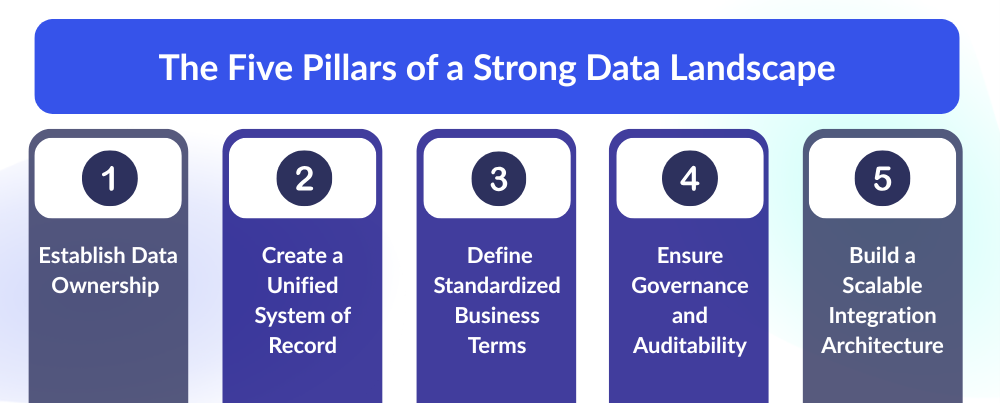
The Five Pillars of an AI-Ready Enterprise Data Landscape
Sustainable AI readiness does not come from isolated AI projects, but from a solid enterprise data architecture. Companies that want to make their organization AI-ready in the long term should address five key areas.
1. Establish Data Ownership
Every business-critical data domain needs clearly defined responsibilities. Only then can data quality and governance be ensured over the long term.
2. Create a Clear System of Record
For core enterprise data, it should be clearly defined which source is authoritative. Multiple versions of the truth prevent reliable AI results.
3. Define Consistent Business Terms
A company-wide business glossary prevents different interpretations of key metrics and creates the basis for consistent analyses.
4. Ensure Governance and Auditability
Role-based access rights, full traceability, and compliance are becoming increasingly important due to the EU AI Act and other regulatory requirements.
5. Build a Scalable Integration Architecture
A robust integration platform connects ERP, CRM, cloud services, legacy applications, and data platforms to create a consistent information foundation for analytics and AI.
Why AI Budgets Are Shifting Toward Data Integration and Governance
A clear trend is emerging. While 88% of companies are already using AI, only about one-third have managed to scale it across the enterprise, according to the McKinsey State of AI Survey. As a result, investments are increasingly shifting away from isolated AI applications and toward data integration and governance.
The reason is simple: Today’s competitive differentiation no longer lies between companies that use AI and those that do not. It lies between companies whose data landscape truly supports AI and those whose projects fail because of data quality, governance, or missing integration. Architecture is becoming the decisive performance lever — not the next AI model.
Modern Data Platforms Reduce Complexity and Prevent New Data Silos
As AI requirements increase, modern data platforms are changing as well. Instead of constantly copying data or creating new silos, current platform strategies increasingly rely on intelligent integration layers. Context, metadata, and governance are moving closer to the integration and data layer. This enables AI applications to access distributed data without having to replicate it multiple times.
For companies, this means:
- fewer data copies,
- fewer inconsistencies,
- better governance,
- higher data quality, and
- faster data availability for AI applications.
Major technology providers are now developing their platform strategies in exactly this direction.
AI Readiness Checklist: Is Your Data Landscape Ready for AI?
Before launching additional AI projects, companies should be able to answer a few fundamental questions:
- Are responsibilities for business-critical data clearly defined?
- Is there a clearly defined system of record for core data?
- Do all departments use the same business definitions?
- Can data flow reliably between ERP, CRM, cloud, and legacy systems?
- Are access, data lineage, and changes fully traceable?
- Do existing integration processes support analytics and AI applications without extensive manual data preparation?
If several of these questions are answered with “no,” modernizing the data and integration architecture should take priority over further AI investments.
Conclusion: AI Readiness Turns Data Integration into AI Business Value
Companies no longer need to decide whether they should use AI. The critical question is: Is our data landscape ready for AI?
AI readiness is not a one-time project, but an ongoing maturity process. Companies that invest in enterprise integration, data governance, data quality, and a modern data architecture today create the foundation for trustworthy AI applications and secure long-term competitive advantages.
With MagicTouch, Magic Software helps companies intelligently connect existing systems, data, and processes — creating the prerequisites for scalable AI readiness. The cloud-native integration platform connects cloud and on-premises systems, integrates data in real time, and creates a controlled, scalable enterprise data foundation for analytics, data governance, and AI initiatives. This turns individual AI pilot projects into a sustainable enterprise AI strategy.
Is Your Enterprise Data Ready for AI?
Download our free CIO Guide “Preparing Enterprise Data for AI” and learn how to build an AI-ready data landscape:
- which five requirements an AI-ready data landscape must meet,
- how to improve data integration and governance in a targeted way, and
- which checklist helps you assess your organization’s maturity level.
👉 Start the AI Readiness Check Now